
The hyper-growth customer support problem.
Issues grow exponentially with the customers, support staff grows linear at best. No amount of hiring closes that gap. Less support, said openly, and self-support resources do.

Key takeaways
- More customers mean more issues: the need for support grows with the company.
- Hiring support agents grows linear at best, and a bigger support team gets less efficient.
- Slowing down growth would fix it, but a company sold to VCs as hyper-growth will not do that.
- Stop hiring additional support and make nearly non-existent support a clearly communicated fact.
- Put the money into self-support resources that fix the biggest pain points at the root cause.
Hyper-growth (unicorn) companies get support so wrong that clients start petitions to get any kind of response. Even the mainstream press reports it. The reason is systematic.
Hyper-growth startups aim to grow exponentially
The more they grow, the more they grow, by whatever metric they see fit. At market saturation they jump into neighbouring markets.
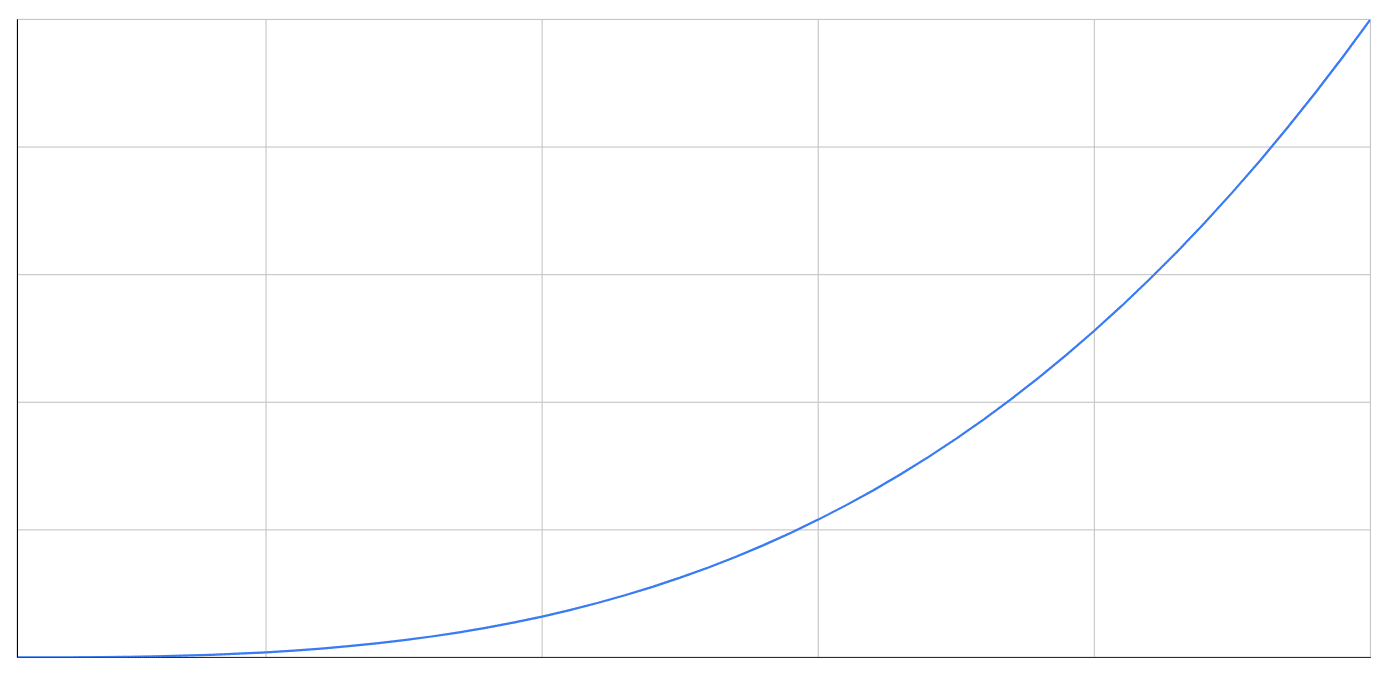
Blue might be customers, revenue, …
With enough money, creativity and no shame, a mixture of these might even work for a time:
- going viral, customers referring customers, word of mouth
- aggressive scale-up sales
- VC money thrown into Google and Facebook/Meta online ads
- growth hacking, spam, building a market
More customers, more issues
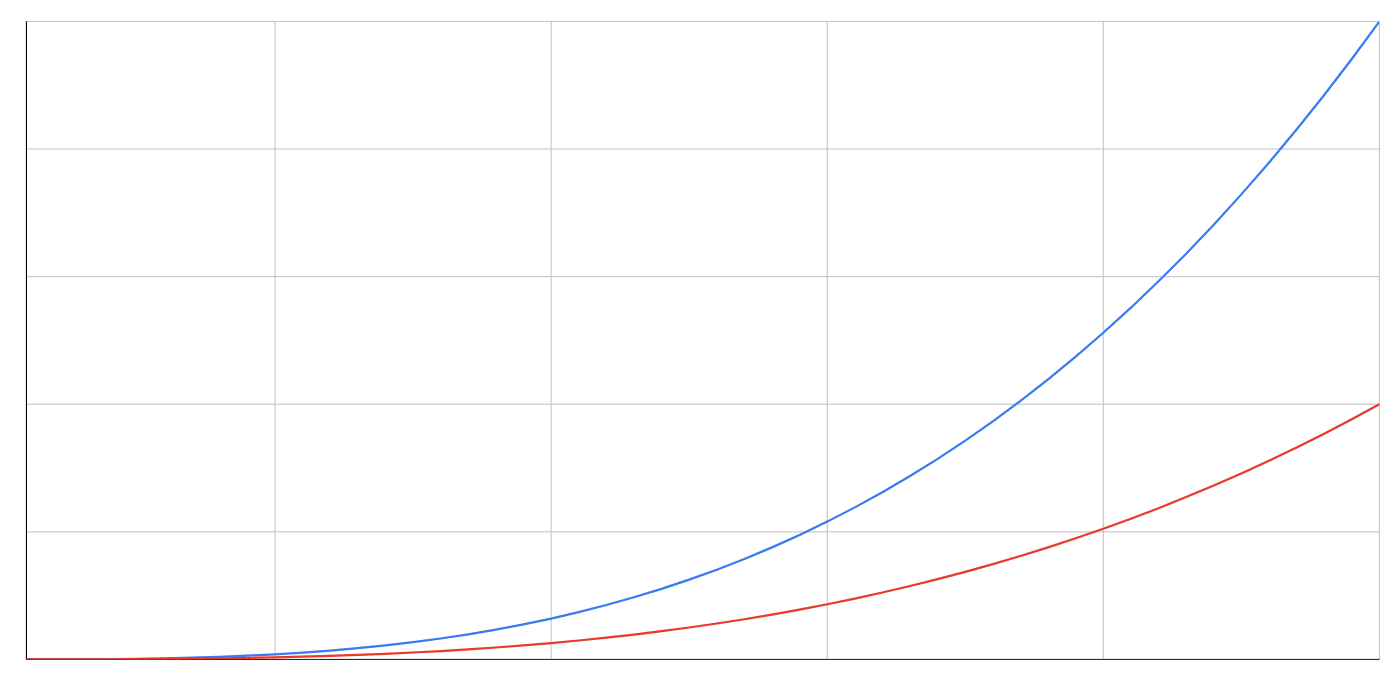
Customers (sometimes called partners) are humans, and humans create problems. Always. The need for support (red) grows with the company.
Support hiring grows linear at best
So companies hire customer support agents. Hiring people grows linear at best (yellow).
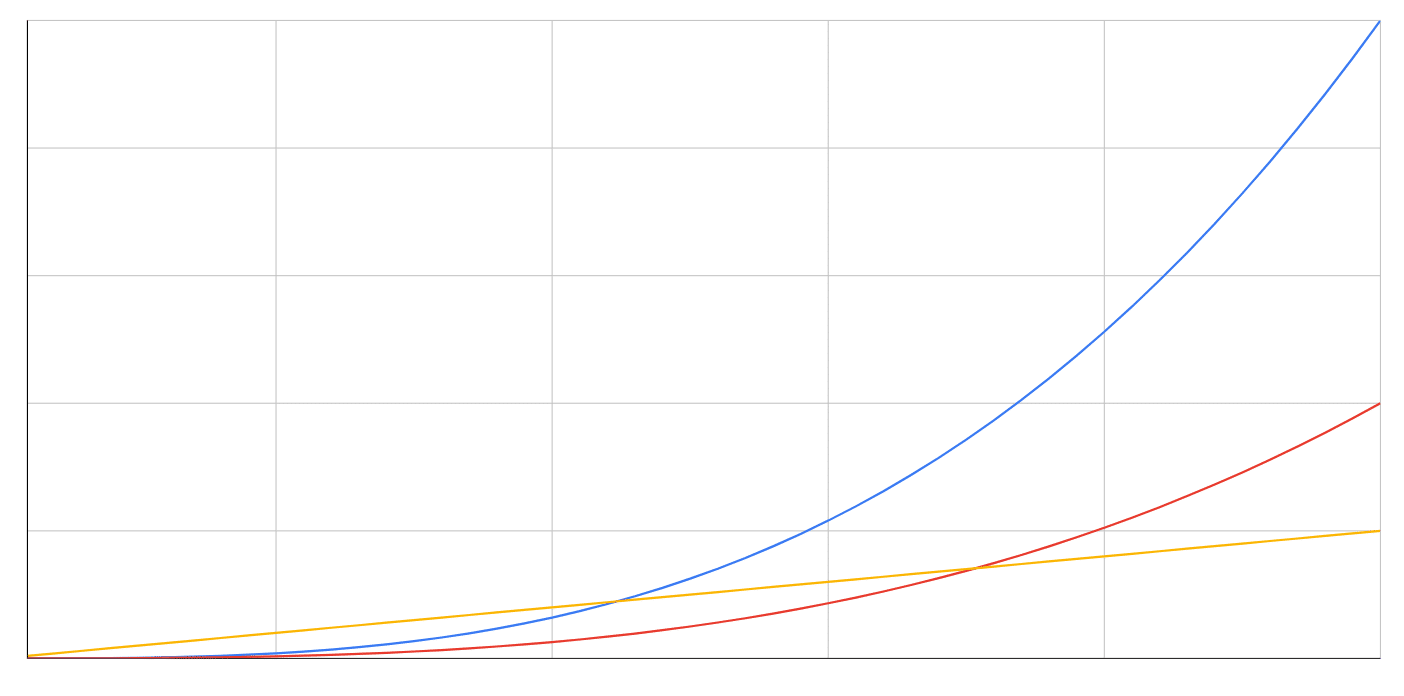
- The bigger the support team, the less efficient it becomes: internal complexity, friction, turnover.
- The growth puts the whole organisation under more and more pressure, at the very least in burn rate.
Your support sucks. If not yet, it will.
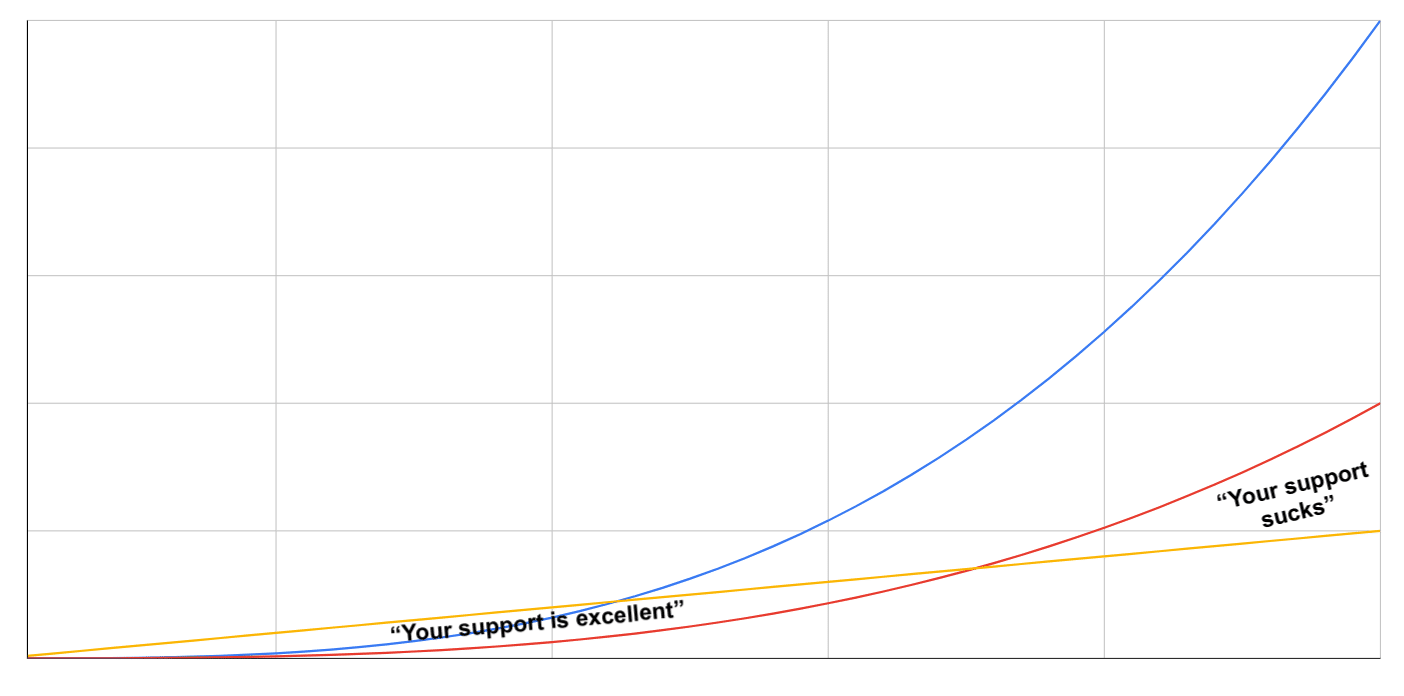
Even a company that had the best support in the past ends up with shitty support, no matter how much money it invests or how fast it hires. A huge support team also strains the organisation, not only money-wise.
Three options, one of them unrealistic
- Slow down, stop growing exponentially.
- Less support, and acceptance that your support sucks.
- Customers support themselves.
Option 1 is not going to happen. They sold a hyper-growth company to the VCs, now they need to deliver. So 2 and 3 are the way to go.
Stop hiring support and say so
Stop hiring additional support as long as you are ahead of the curve.
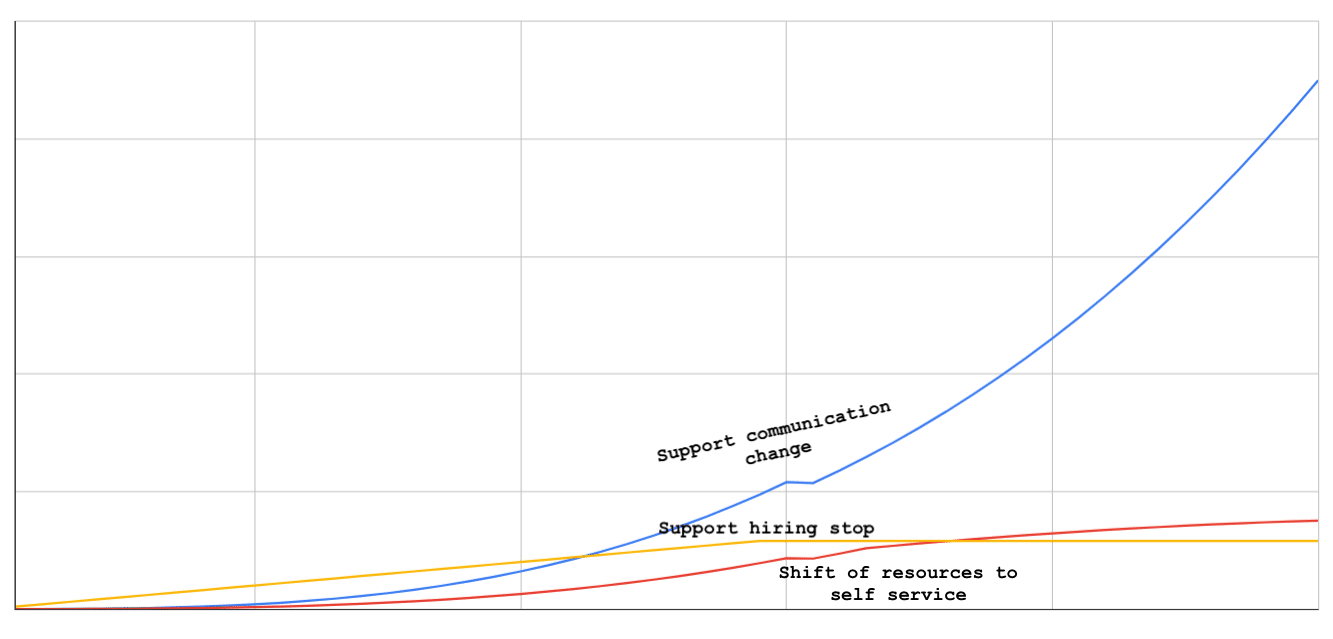
Make nearly non-existent support part of the cost of doing business with you: a known fact, clearly communicated.
It limits how many and what kind of customers you get (delayed growth). But users and the organisation adapt quickly to a known constant, not to a constant struggle.
Shift the resources to self-support
Put the money and the internal effort into highly maintained resources that enable users to support themselves and that get better over time:
- bottom-up forums
- top-down managed wikis
- self-support wizards and tools
- processes that keep identifying the biggest pain points and solve them one after the other, at the root cause, not on the support layer
- on the support side, for users who manage to reach it: self-serving defaults that solve the easy cases well enough, quickly
Your support will still suck in some cases, but in fewer than in the old-school scenario.
The future: a learning layer between customers and support
A few months before I wrote this in April 2022, I was at a machine learning surf camp. Late at night, drunk, the trainers and I discussed whether ML could solve this: a learning layer that makes support better with every interaction between customers and support team.
The answer was: “Definitely, let’s make that a startup! It will be a unicorn.”